


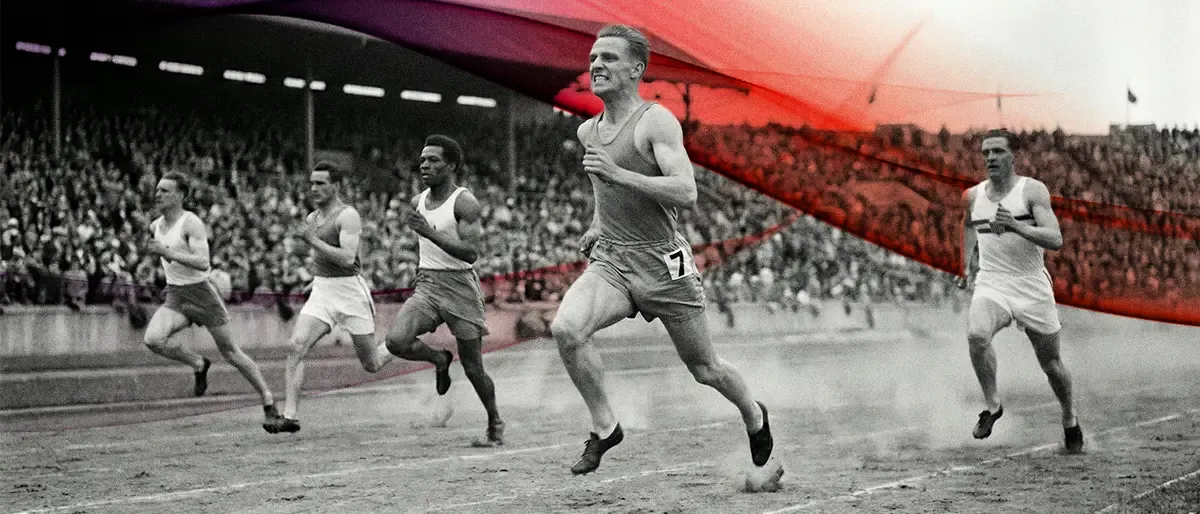
The 45 most unforgettable Olympic moments in history
The Olympic Games are more than medals and podiums—they are a living timeline of human ambition, resilience, and unity. Every two years, the world pauses to watch athletes push past perceived limits, represent their nations with pride, and create moments that ripple far beyond sports.
From record-shattering performances to quiet acts of courage, the most unforgettable Olympic moments remind us what’s possible when preparation meets opportunity on the world’s biggest stage.
To celebrate the upcoming Winter Olympics and DISH’s 45th anniversary, we decided to look back on the 45 greatest Olympic moments of all time.
What makes an Olympic moment unforgettable?
Not every medal becomes history. The most memorable Olympic moments tend to share a few defining traits:
- Historic impact: Performances or events that changed the sport—or the world—forever.
- Emotional resonance: Triumph, heartbreak, perseverance, or unity felt across borders.
- Cultural significance: Moments that transcended competition and entered global consciousness.
- Athletic excellence: Feats once thought impossible, achieved under immense pressure.


The 45 most unforgettable Olympic moments
1. Jesse Owens Defies Expectations: Berlin 1936
Winning four gold medals in Nazi Germany, Jesse Owens shattered Adolf Hitler’s vision of Aryan supremacy and delivered one of the most powerful statements in Olympic history.
2. Miracle on Ice: Lake Placid 1980
A team of U.S. college players stunned the dominant Soviet Union in ice hockey, creating the ultimate underdog victory during the Cold War.
3. Usain Bolt Redefines Speed: Beijing 2008
Bolt’s world-record sprints—and relaxed celebrations—made him the face of modern Olympic dominance.
4. Nadia Comăneci Scores the First Perfect 10: Montreal 1976
The scoreboard wasn’t ready for perfection, but Comăneci’s flawless routine forever changed gymnastics.
5. Michael Phelps Becomes the Most Decorated Olympian: 2008 & 2012
With 23 gold medals, Phelps set a standard of sustained excellence unmatched in Olympic history.
6. Muhammad Ali Lights the Olympic Flame: Atlanta 1996
Battling Parkinson’s disease, Ali’s trembling hands delivered one of the most emotional ceremonies ever.
7. Simone Biles Redefines Gymnastics: Rio 2016
Biles introduced moves so difficult they were named after her, reshaping the sport’s ceiling.
8. Wilma Rudolph’s Golden Comeback: Rome 1960
Once unable to walk due to polio, Rudolph became the fastest woman in the world.
9. The First Women’s Marathon: Los Angeles 1984
Joan Benoit’s victory marked a monumental step forward for women’s Olympic competition.
10. Cathy Freeman’s Home-Gold Triumph: Sydney 2000
Freeman’s 400-meter win became a symbol of reconciliation and national pride in Australia.
11. The Black Power Salute: Mexico City 1968
Tommie Smith and John Carlos used the medal podium to spotlight civil rights, creating one of the most iconic Olympic images ever.
12. Kerri Strug’s Vault: Atlanta 1996
Competing on an injured ankle, Strug clinched team gold with a single courageous vault.
13. Abebe Bikila Wins Barefoot: Rome 1960
Running without shoes, Bikila became the first sub-Saharan African Olympic champion.
14. Eric “The Eel” Moussambani Finishes the Race: Sydney 2000
Though far from elite, his determination captured hearts worldwide.
15. Olga Korbut’s Emotional Gymnastics: Munich 1972
Korbut’s expressive routines introduced artistry and vulnerability to gymnastics.
16. The Refugee Olympic Team Debuts: Rio 2016
Athletes without a homeland competed under the Olympic flag, symbolizing hope.
17. Bjørn Dæhlie’s Cross-Country Dominance: 1990s Winter Games
The Norwegian legend became the most decorated Winter Olympian of his era.
18. Snowboarding Makes Its Olympic Debut: Nagano 1998
A new generation and culture officially entered the Olympic movement.
19. Shaun White’s Perfect Halfpipe Run: Vancouver 2010
White’s gravity-defying performance elevated snowboarding’s global profile.
20. Apolo Ohno’s Short Track Legacy: 2002–2010
Ohno became the most decorated U.S. Winter Olympian through tactical brilliance.
21. The Jamaican Bobsled Team: Calgary 1988
A feel-good underdog story that proved the Olympics are about more than medals.
22. Kristi Yamaguchi’s Figure Skating Gold: Albertville 1992
Her elegance helped popularize figure skating across the U.S.
23. The First Unified Korean Team: PyeongChang 2018
North and South Korea marched together, showcasing sport’s diplomatic power.
24. Derek Redmond’s Finish: Barcelona 1992
With his father's help, Redmond completed his race despite injury, embodying the Olympic spirit.
25. The “Dream Team” Dominates: Barcelona 1992
NBA stars transformed Olympic basketball into a global spectacle.
26. Larisa Latynina’s Medal Record: 1956–1964
Latynina’s longevity set a benchmark before the Phelps era.
27. Bob Beamon’s Impossible Long Jump: Mexico City 1968
His leap shattered records by nearly two feet.
28. The First Olympic Gold for China: Los Angeles 1984
A milestone moment in China’s sporting emergence.
29. Oscar Pistorius Competes with Able-Bodied Athletes: London 2012
A groundbreaking moment for inclusion in Olympic competition.
30. The Munich Memorial: Munich 1972
A somber reminder of tragedy and resilience within Olympic history.
31. Women’s Boxing Debuts: London 2012
Opening the door for future generations of fighters.
32. Clara Hughes Medals in Summer & Winter Games: 1996–2010
A rare cross-discipline Olympic achievement.
33. The Introduction of Skateboarding: Tokyo 2020
Youth culture reshaped the Olympic image.
34. Eliud Kipchoge’s Marathon Masterclass: Tokyo 2020
A dominant performance under extreme conditions.
35. Tokyo 2020 Amid a Pandemic
Athletes competed in empty venues, redefining perseverance.
36. The Olympic Oath of Inclusion: Paris 1900 Women Debut
Women first competed, altering the Games forever.
37. Alpine Skiing’s Rise: 1936 Winter Games
A sport that became a Winter Olympic staple.
38. Simone Manuel Breaks Barriers: Rio 2016
The first Black woman to win Olympic gold in swimming.
39. Speed Skating’s Technological Revolution: 1990s
Equipment advances reshaped Winter Olympic records.
40. The Lighting of the Tokyo 1964 Flame
Symbolized Japan’s post-war reemergence.
41. Allyson Felix’s Medal Legacy: 2004–2020
A career defined by longevity and advocacy.
42. The First Paralympic-Olympic Crossover Stars
Athletes inspiring broader inclusion.
Summer vs. Winter Olympics: Moments that defined each era
While every Olympic Games shares a commitment to excellence, the Summer and Winter Olympics have produced distinctly different types of unforgettable moments, shaped by their environments, scales, and athletic demands.
Summer Olympics: Global scale and cultural milestones
The Summer Games are often remembered for their sheer size and cultural reach. With dozens of sports and thousands of athletes, they frequently become platforms for historic firsts, political statements, and record-breaking Olympic performances that resonate far beyond the competition.
Defining traits of Summer Olympic moments include:
- Massive global participation across continents and cultures
- Iconic stadium settings and worldwide television audiences
- Breakthrough moments for women, marginalized athletes, and emerging nations
Stat callouts:
- The Summer Olympics feature 33+ sports and more than 300 medal events
- Tokyo 2020 welcomed athletes from 206 nations, the most in Olympic history
- Athletics and swimming account for over 25% of all Olympic medals ever awarded
From Jesse Owens’ dominance in Berlin to Simone Biles redefining gymnastics difficulty, Summer Olympics moments often become symbols of social progress and global unity.
Winter Olympics: Precision, risk, and elemental challenge
The Winter Games, by contrast, deliver unforgettable moments through speed, control, and survival against nature itself. Events are decided by hundredths of a second, where a single misstep can end years of preparation.
What defines iconic Winter Olympic moments:
- Extreme conditions involving ice, snow, and altitude
- Smaller fields where rivalries become intensely personal
- High-risk disciplines that reward technical perfection
Stat callouts:
- Alpine downhill racers routinely reach speeds of 80–90 mph
- Speed skating medals are often decided by 0.01–0.05 seconds
- Just five nations have historically won nearly 30% of all Winter Olympic medals, intensifying rivalries
From the Miracle on Ice to Shaun White’s halfpipe mastery, Winter Olympics moments often feel raw, dramatic, and deeply human—where control meets chaos.
Together, Summer and Winter Games showcase the full range of Olympic excellence, creating defining moments that shape each era in unique ways.
How the Olympics have evolved over the decades
Since the modern Olympic Games began in 1896, they have evolved from a modest international competition into one of the most-watched and culturally influential events on the planet. As the Games have grown, so too have the unforgettable Olympic moments that reflect shifting values, technology, and global participation.
From amateur ideals to elite professionalism
Early Olympians often trained part-time, competing for national pride rather than financial reward. Today’s Olympic athletes are full-time professionals, supported by sports science, analytics, nutrition, and global competition pipelines.
Stat callouts:
- Early Olympians sometimes competed in multiple unrelated sports at a single Games
- Modern elite athletes often train for 10–12 years for one Olympic cycle
This evolution has pushed human performance to new limits, resulting in faster times, higher scores, and more sustained Olympic dynasties than ever before.
Global participation and representation
The Olympics have transformed from a Eurocentric event into a truly global competition. Expansion in participation has fueled many of the most historic moments in Olympic history.
Stat callouts:
- The 1896 Olympics featured 14 countries and 241 athletes
- Recent Summer Games include 11,000+ athletes from over 200 nations
- Women now account for nearly 50% of all Olympic competitors, compared to zero in 1896
This growth has led to emotional Olympic moments such as nations winning their first-ever medals, refugee athletes competing under the Olympic flag, and expanded opportunities across gender and geography.
Technology, broadcasting, and the fan experience
How fans experience Olympic moments has changed dramatically. What was once relayed by newspapers and radio is now delivered instantly across screens worldwide.
Key evolutions:
- Timing and photo-finish technology accurate to 1/1000th of a second
- High-definition and 4K broadcasts capturing every detail
- Multi-event viewing that allows fans to follow dozens of sports simultaneously
These advancements ensure that today’s greatest Olympic moments are not just seen—but shared, replayed, and remembered instantly.
Athlete advocacy and social impact
Modern Olympic moments increasingly include athletes using the global stage to speak beyond sport. From civil rights demonstrations to mental health advocacy, Olympians now shape conversations as both cultural leaders and competitors.
Many of the most iconic Olympic moments of recent decades reflect courage, vulnerability, and leadership off the field of play.


Watching the Olympics today
The way fans experience the Olympic Games has evolved just as much as the competition itself. Today’s viewers expect comprehensive coverage, flexible viewing options, and crystal-clear picture quality—especially during a global event where multiple unforgettable moments can happen at once. Whether it’s a must-see gold medal race or a surprise underdog victory, modern Olympic coverage makes it easier than ever to stay connected to every event.
Where to watch the Olympics on DISH
Olympic coverage in the U.S. airs across NBCUniversal networks, giving viewers access to live events, replays, and in-depth analysis throughout the Games. With DISH, fans can follow the action across:
- NBC for marquee events and primetime coverage
- USA Network for live competitions and extended daytime coverage
- CNBC for additional events and overflow programming
- Peacock simulcasts (when available) for expanded viewing options
This multi-network approach ensures fans don’t miss iconic Olympic moments as they unfold—no matter the sport or time of day.
How DISH enhances the Olympic viewing experience
When the world’s biggest sporting moments are happening simultaneously, having the right TV setup matters. DISH is built to handle the scale and excitement of the Olympic Games.
Key features for Olympic fans include:
- Hopper DVR to record multiple events at once, so nothing gets missed
- HD and 4K broadcasts that bring Olympic venues and performances to life
- Multi-event recording and playback, perfect for busy schedules and must-see replays
From opening ceremonies to medal-clinching finishes, DISH helps turn today’s Olympic coverage into tomorrow’s unforgettable memories.
Get ready for the next unforgettable Olympic moment—explore DISH packages built for sports fans.
Looking ahead to future Olympic Games
As the Games continue to evolve, so do the moments that define them. Upcoming Olympics promise new stories, new stars, and new chapters in Olympic history.
Milano-Cortina 2026: Winter Olympics
Set against the dramatic backdrop of the Italian Alps, the 2026 Winter Games will blend historic venues with modern innovation. With events spread across multiple regions, Milano-Cortina is expected to showcase both classic winter disciplines and cutting-edge competition.
Los Angeles 2028: Summer Olympics
Returning to the United States, the Los Angeles 2028 Summer Olympics will spotlight the future of global sport. With a focus on sustainability, technology, and youth engagement, LA 2028 is poised to deliver moments that resonate far beyond the medal count.
Why Olympic moments continue to evolve
Each new Olympic Games reflects the world in which it takes place. Advances in training, inclusion, technology, and storytelling ensure that future Games will produce moments that are faster, bolder, and more globally connected than ever before.
Final thoughts
The Olympics endure because they speak a universal language—one of perseverance, excellence, and shared humanity. Across decades, borders, and disciplines, unforgettable Olympic moments remind us that greatness can come from anywhere and inspire everyone.
From historic firsts and emotional comebacks to future milestones yet to be written, the Olympic Games remain a celebration of what the world can achieve together. And as new generations gather to watch, cheer, and remember, the next unforgettable moment is always just one Games away.
From historic breakthroughs to future milestones, the Olympic Games continue to deliver moments worth watching live. Call 833-970-6244 to learn how DISH helps you experience every event in stunning quality.